Description
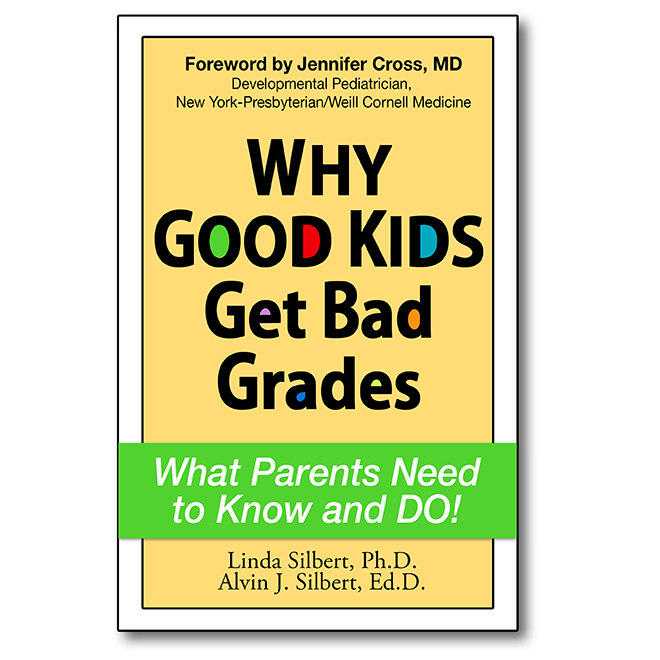
Why Good Kids Get Bad Grades:
What Parents Need to Know and Do
By Linda Silbert, Ph.D. and Alvin J. Silbert, Ed.D.
Foreword by Jennifer Cross, MD, Developmental Pediatrician, New York-Presbyterian/Weill Cornell Medical Center
Why do capable, motivated children struggle academically? In this thoroughly updated and expanded edition, renowned educators Linda and Alvin Silbert reveal the real reasons behind poor grades—and show parents exactly how to help.
Nearly two decades after their groundbreaking first edition, the Silberts return with fresh insights for today’s families. While smartphones, social media, and a global pandemic have transformed childhood, the fundamentals of how children learn remain unchanged. This comprehensive guide cuts through the noise to address both timeless challenges and modern obstacles that stand between good kids and academic success.
Move Beyond Symptoms to Solutions
When children bring home disappointing grades, the easy assumption is that it’s due to laziness or a lack of motivation. But the Silberts demonstrate that struggling students are often hardworking and engaged—they’re simply facing unidentified obstacles. Through expanded case studies and decades of expertise, this book teaches parents to investigate root causes across four critical areas: physical issues (from vision problems to ADHD), social challenges (peer pressure, family discord), educational gaps (study skills, teacher-student mismatch), and psychological factors that influence learning.
Practical Strategies for Real Results
Packed with actionable advice, this guide explores how emotions and social dynamics affect school performance, examines the two primary grade determinants (tests and homework), and reviews the top 12 essential study skills. You’ll discover concrete strategies for addressing homework challenges, navigating issues beyond your child’s control, and creating an environment where learning thrives—even amid digital distractions and modern pressures.
Written in a clear, approachable style with empathy and expertise, Why Good Kids Get Bad Grades is an invaluable resource for parents, teachers, and anyone committed to helping children overcome academic struggles and reach their full potential.
Soft cover: 232 pages
Dimensions: 5.5 x 0.53 x 8.5 inches
Available in Paperback and Kindle
Kindle ISBN: 978-0-89544-579-7
Paperback ISBN: 978-0-89544-578-0
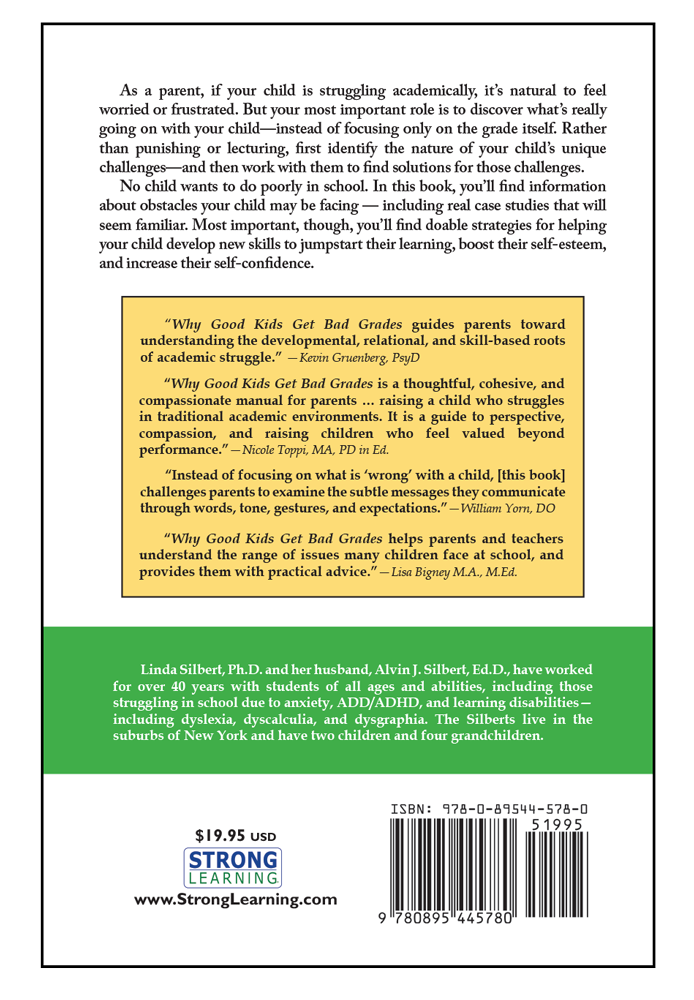
Praise for Why Good Kids Get Bad Grades
“As a clinical child psychologist and parenting expert, I deeply appreciate how Why Good Kids Get Bad Grades offers a practical, relationship-based, and developmentally-grounded approach to understanding learning challenges. The book is built on the psychological insight that trusted, safe and connected relationships are a precontext for learning and working through challenges.
The authors provide strong examples and relatable vignettes that bring complex dynamics to life, helping parents recognize their own families in the stories. Their framework is refreshingly depathologizing and empathic. Instead of labeling children as lazy or oppositional, it guides parents toward understanding the developmental, relational, and skill-based roots of academic struggle. The tips for supporting learning, improving study skills, and building responsibility are concrete and accessible. This is a compassionate, clear, and useful resource for parents and professionals alike.” —Kevin Gruenberg, PsyD, Clinical Child Psychologist and Executive Director of Love, Dad, Los Angeles, California
“Why Good Kids Get Bad Grades offers an important shift in how we think about struggling students. Instead of focusing on what is “wrong” with the child, it challenges parents to examine the subtle messages they communicate through words, tone, gestures, and expectations. It takes a different approach to show us how children interpret emotional cues and build their sense of self-worth and the impact on their school performance—and what families can do differently to help them thrive. WHAT A WONDERFUL BOOK! I will be recommending this to MANY of my patients’ parents.” —William Yorn, DO, Pediatric Neurologist, Connecticut Children’s Medical Center, Farmington, CT
“Why Good Kids Get Bad Grades is a thoughtful, cohesive, and compassionate manual for parents navigating the challenges of raising a child who struggles in traditional academic environments. It is a guide to perspective, compassion, and raising children who feel valued beyond performance.
As a parent of a neurodiverse child who experienced school-related trauma and overwhelm, I cannot say enough positive things about this book. It resonated with me both personally and professionally. As a former school counselor and a mom, I have witnessed firsthand the ever-growing academic and social pressures placed on children—and the parallel exhaustion and overwhelm experienced by parents trying to help them survive in a world increasingly geared toward productivity and performance.
This book is rich with decades of research, practical insight, and real-world perspective. It dives deeply into the inner world of a child who desperately longs to be seen, understood, and accepted—regardless of how they may appear “on paper.”
It powerfully reframes the conversation, reminding parents to embrace the child they have, rather than the one they once envisioned, and the necessity of seeing the whole child. From that place of acceptance, resilience can truly grow.” —Nicole Toppi, MA, PD in Ed., CPC, Brewster, New York
“If you are seeking help for a struggling student, this book provides straightforward answers to complicated questions about why some children have difficulties at school. Why Good Kids Get Bad Grades helps parents and teachers understand the range of issues many children face at school, and provides them with practical advice.” —Lisa Bigney M.A., M.Ed., Co-Director of RI Tutorial & Educational Services, Providence, Rhode Island
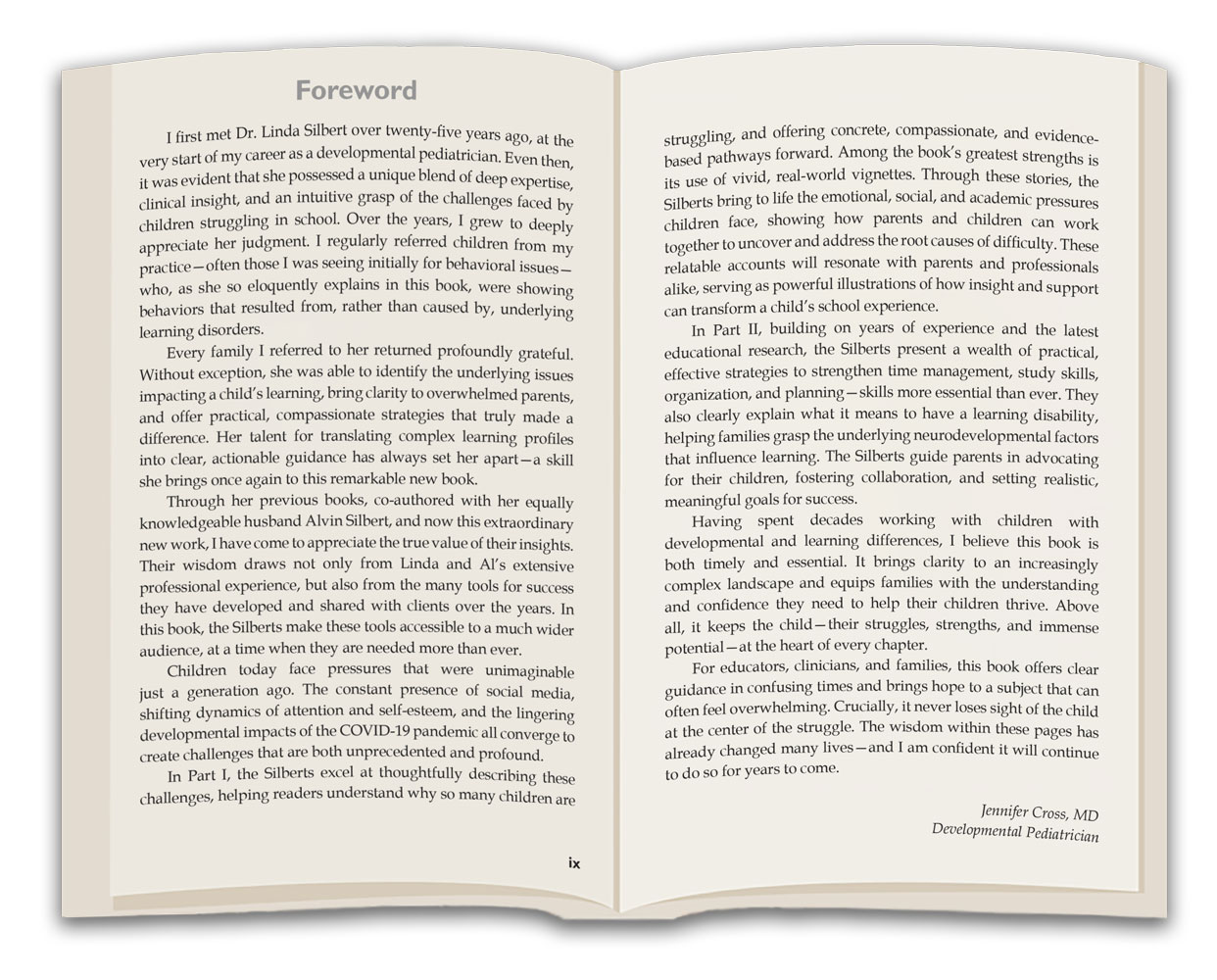
Foreword
I first met Dr. Linda Silbert over twenty-five years ago, at the very start of my career as a developmental pediatrician. Even then, it was evident that she possessed a unique blend of deep expertise, clinical insight, and an intuitive grasp of the challenges faced by children struggling in school. Over the years, I grew to deeply appreciate her judgment. I regularly referred children from my practice—often those I was seeing initially for behavioral issues—who, as she so eloquently explains in this book, were showing behaviors that resulted from, rather than caused by, underlying learning disorders.
Every family I referred to her returned profoundly grateful. Without exception, she was able to identify the underlying issues impacting a child’s learning, bring clarity to overwhelmed parents, and offer practical, compassionate strategies that truly made a difference. Her talent for translating complex learning profiles into clear, actionable guidance has always set her apart—a skill she brings once again to this remarkable new book.
Through her previous books, co-authored with her equally knowledgeable husband Alvin Silbert, and now this extraordinary new work, I have come to appreciate the true value of their insights. Their wisdom draws not only from Linda and Al’s extensive professional experience, but also from the many tools for success they have developed and shared with clients over the years. In this book, the Silberts make these tools accessible to a much wider audience, at a time when they are needed more than ever.
Children today face pressures that were unimaginable just a generation ago. The constant presence of social media, shifting dynamics of attention and self-esteem, and the lingering developmental impacts of the COVID-19 pandemic all converge to create challenges that are both unprecedented and profound.
In Part I, the Silberts excel at thoughtfully describing these challenges, helping readers understand why so many children are struggling, and offering concrete, compassionate, and evidence-based pathways forward. Among the book’s greatest strengths is its use of vivid, real-world vignettes. Through these stories, the Silberts bring to life the emotional, social, and academic pressures children face, showing how parents and children can work together to uncover and address the root causes of difficulty. These relatable accounts will resonate with parents and professionals alike, serving as powerful illustrations of how insight and support can transform a child’s school experience.
In Part II, building on years of experience and the latest educational research, the Silberts present a wealth of practical, effective strategies to strengthen time management, study skills, organization, and planning—skills more essential than ever. They also clearly explain what it means to have a learning disability, helping families grasp the underlying neurodevelopmental factors that influence learning. The Silberts guide parents in advocating for their children, fostering collaboration, and setting realistic, meaningful goals for success.
Having spent decades working with children with developmental and learning differences, I believe this book is both timely and essential. It brings clarity to an increasingly complex landscape and equips families with the understanding and confidence they need to help their children thrive. Above all, it keeps the child—their struggles, strengths, and immense potential—at the heart of every chapter.
For educators, clinicians, and families, this book offers clear guidance in confusing times and brings hope to a subject that can often feel overwhelming. Crucially, it never loses sight of the child at the center of the struggle. The wisdom within these pages has already changed many lives—and I am confident it will continue to do so for years to come.
Jennifer Cross, MD, Developmental Pediatrician,
New York-Presbyterian/Weil Cornell Medical Center, New York, New York
Reviews for the 2007 edition:
“I strongly recommend this book for any parent whose child is experiencing difficulties in school, or for any parent, for that matter. They may gain an insight to some of their own, possibly less than acceptable, parent-child thought or action patterns.” — John H. Manhold, Psychological Counselor and Past President, Academy of Psychosomatic Medicine
“This book actually causes you to think about how you interact with your children and things that you could say or do in various real situations. It is beautifully written with entertaining anecdotes that you want to remember and repeat to your friends.” — Venkatesh Garani, parent
“I wish Drs. Linda and Al Silbert had written this informative book when I was teaching. I would have recommended it to all those parents who wanted and needed help with raising their children. Their advice is “user friendly” for parents of all ages and educational levels.” — E. Purcigliotti, NYS, K-12 educator
“All parents want to raise happy, successful kids. With the S+T+R+O+N+G method, parents can improve communication, encourage their children, and guide them towards achievement.” — Marc E. Childs, M.D., Assistant Professor of Pediatrics, New York Medical College
“Drs. Linda and Alvin Silbert use the wisdom gained over many years of experience to help parents nurture their children to become better students and, more importantly, to lead happier and more fulfilling lives. By seeing the complete child, Why Bad Grades Happen to Good Kids focuses not just on better grades, but on a better life for your child.” — Kevin T. Kalikow, M.D., Psychiatrist, Author of Your Child in the Balance
“Self-esteem is critical to success in life. Linda and Al share practical action steps parents can take now to promote a positive image-whether the child is a toddler or teenager.” — Daniel F. Joynt, Pd.D., Professor of Counselor Education, Western Connecticut State University
“Real-life advice on how your child can do better in school, in language we can all understand. An excellent book.” — Linda Selvin, Executive Director, New York Branch, International Dyslexia Association
SKU: 578